
Bathymetry Mapping Services

Professional bathymetry mapping services using advanced drone-mounted LiDAR technology to deliver accurate underwater topography data. Our bathymetric survey solutions combine cutting-edge green laser technology with traditional hydrographic survey methods to map lakes, reservoirs, rivers, basins, coastal areas, and marine environments with unprecedented speed and accuracy.
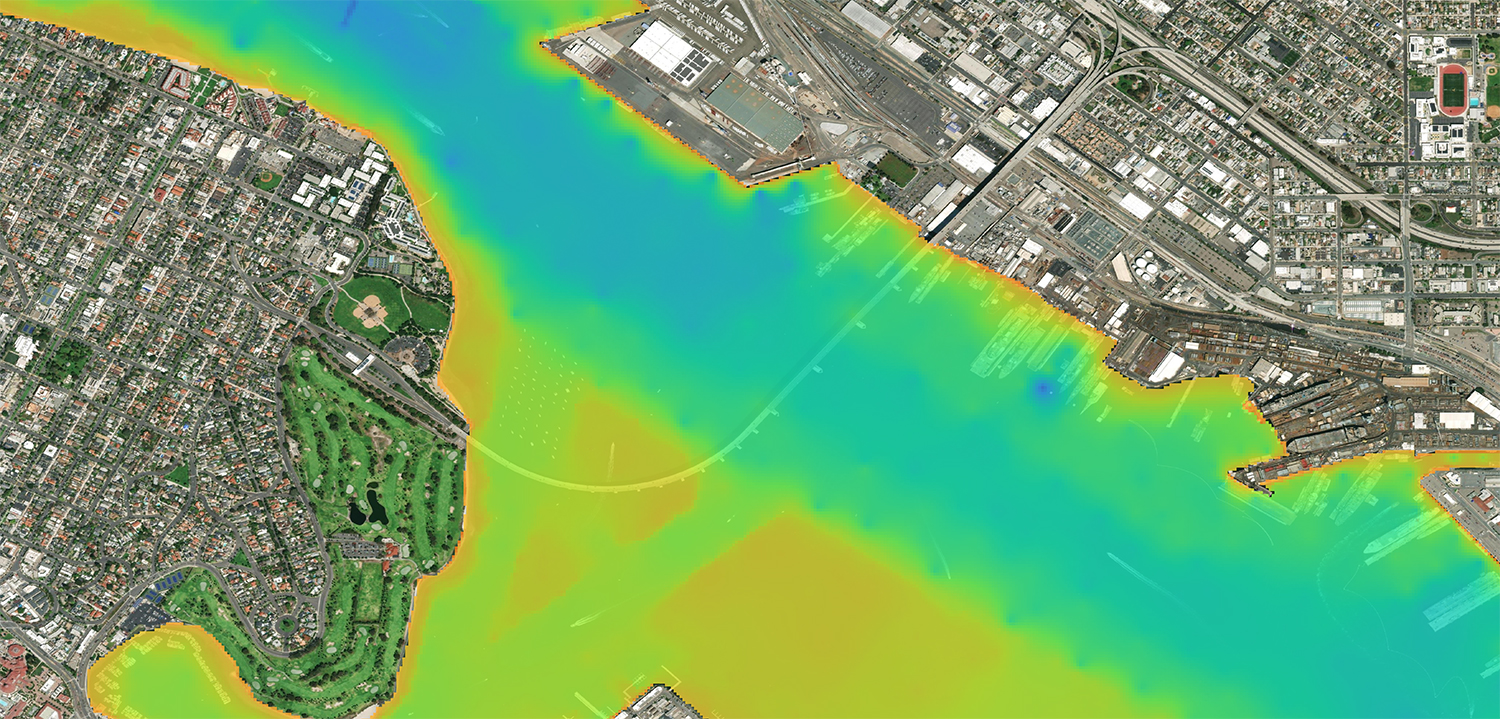
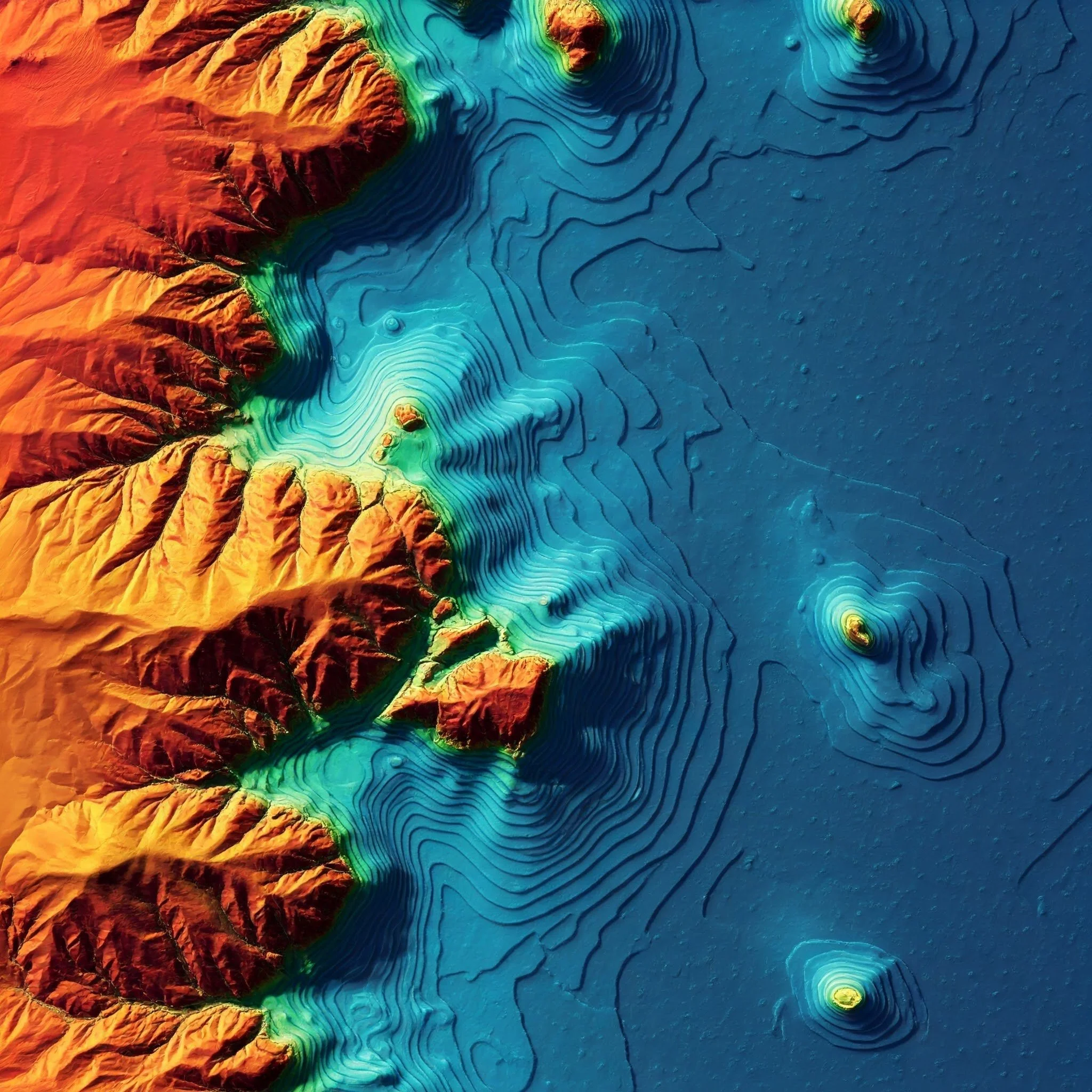
bathymetry

10+

Water Bodies Mapped

2-10cm

Survey Accuracy

1-3 Days

Typical Turnaround

500+

Acres Surveyed

Bathymetric Mapping Services

Understanding Bathymetric Mapping and Hydrographic Surveys

Unlike traditional boat-based bathymetry services that require weeks of field work and expensive vessel mobilization, our drone bathymetric mapping approach completes surveys in days while maintaining survey-grade accuracy. We serve clients across California and the southwestern United States, providing bathymetric data for engineering, construction, environmental, and resource management applications.

Our team combines FAA-certified drone pilots with advanced data processing capabilities to deliver comprehensive underwater mapping solutions. Whether you need lake bathymetry for sediment analysis, reservoir capacity calculations for dam safety assessments, or coastal bathymetric data for marine construction projects, we provide the precision and reliability your project demands.

Diverse Applications

  • Pre-construction site surveys and planning
  • Environmental impact assessments

  • Sediment management and dredging studies

  • Flood modeling and inundation analysis

  • Fish habitat and ecosystem mapping

  • Underwater archaeology documentation

  • Pipeline and cable route planning

  • Marina and harbor development

  • Beach nourishment projects

  • Dam and levee safety inspections

  • Reservoir capacity monitoring

  • Coastal erosion tracking

Revolutionary Drone-Based
Bathymetry Mapping Technology

How Bathymetric LiDAR Works

Bathymetric LiDAR technology employs green laser wavelengths (typically 532 nanometers) specifically designed to penetrate water surfaces and measure underwater topography. Unlike infrared lasers used in terrestrial LiDAR mapping that reflect off water surfaces, green laser light penetrates clear to moderately turbid water, allowing direct measurement of submerged terrain depths. Our drone-mounted bathymetric LiDAR systems emit thousands of laser pulses per second, capturing dense point clouds representing both water surface elevation and bottom topography simultaneously.

Complete bathymetric survey systems integrate multiple precision components including the green laser scanner, high-accuracy GPS receivers for positioning, inertial measurement units (IMU) for orientation tracking, RGB cameras for visual context, and sophisticated data logging equipment. RTK (Real-Time Kinematic) or PPK (Post-Processed Kinematic) GPS corrections ensure centimeter-level horizontal and vertical accuracy. The integration of these components, combined with rigorous calibration procedures, enables survey-grade bathymetric data suitable for engineering and regulatory applications.

Advantages Over Traditional Bathymetry Methods

Speed & Efficiency

Drone bathymetry mapping completes projects 5-10 times faster than traditional boat-based surveys. Where conventional multibeam hydrographic surveys require days or weeks of vessel operations covering systematic track lines, drone bathymetric LiDAR surveys typical water bodies in hours. For a 100-acre reservoir, traditional bathymetry services might require 3-5 days of boat time plus mobilization, while our drone approach completes data acquisition in a single day.

Superior Access

Many water bodies present significant challenges for boat-based bathymetric surveys including shallow depth preventing vessel access, aquatic vegetation obstructing navigation, rocky or steep shorelines limiting launch points, and safety hazards from swift currents or underwater obstacles. Drone bathymetry eliminates these constraints by surveying from above, accessing areas completely inaccessible to boats. Shallow bays, vegetated wetlands, dangerous rapids, and remote mountain reservoirs all become readily surveyable.

Enhanced Safety

Traditional bathymetric mapping exposes field crews to numerous hazards including boat operations in dangerous waters, cold water exposure risks, underwater obstacles threatening vessels, weather-related dangers on open water, and physical demands of extended boat operations. Drone bathymetry services minimize these risks by conducting surveys from shore-based control positions. No personnel enter hazardous waters, eliminating drowning risks, hypothermia dangers, and vessel collision hazards.

Cost Effectiveness

Bathymetry survey costs using drone technology typically run 50-70% less than equivalent boat-based projects for small to medium-sized water bodies. Traditional hydrographic surveys incur substantial costs for vessel mobilization, multi-person field crews, extended daily rates, specialized boat-mounted equipment, and extensive logistics. Drone bathymetric mapping reduces crew sizes, eliminates vessel costs, completes projects faster, and requires less extensive equipment mobilization.

Technical Capabilities and Performance

Key Technical Specifications

  • Vertical accuracy: 2-10cm RMSE with ground control
  • Horizontal accuracy: 3-10cm RMSE
  • Water penetration: 1-50 meters (clarity dependent)
  • Point density: 10-50 points per square meter
  • Green laser wavelength: 532nm
  • Pulse rate: Thousands per second
  • Coverage: 50-300 acres per day
  • RTK/PPK GPS: Centimeter-level positioning

Bathymetric Survey Methods Compared

Understanding the strengths and limitations of different bathymetry mapping technologies helps you select the optimal approach for your specific project requirements, water conditions, and budget constraints.

Drone LiDAR vs Single-Beam Echo Sounders

Multibeam echo sounders represent the gold standard for traditional bathymetric mapping, using hundreds of narrow acoustic beams to map seafloor topography in wide swaths. While multibeam systems excel for deep water ocean surveys and provide extremely high point density, they require expensive specialized vessels, experienced hydrographers, extensive mobilization logistics, and significant time investment. Drone bathymetric LiDAR offers comparable accuracy for shallow to moderate depth surveys while dramatically reducing survey time and costs. For water bodies under 30 meters depth and 500 acres area, drone bathymetry typically proves more efficient and economical than multibeam hydrographic surveys.

Drone Bathymetric LiDAR vs Multibeam Sonar

Single-beam echo sounders measure water depth along vessel track lines, requiring interpolation between tracks to create continuous bathymetric surfaces. This traditional bathymetry mapping method remains common for lake and reservoir surveys due to lower equipment costs compared to multibeam systems. However, single-beam surveys suffer from poor spatial coverage, requiring extensive vessel time for adequate point density, and produce lower accuracy results than modern alternatives. Drone bathymetric LiDAR captures full-coverage point clouds rather than interpolated surfaces, provides superior spatial resolution, requires less field time, and achieves better vertical accuracy than single-beam methods for comparable project costs.

Drone LiDAR vs Satellite-Derived Bathymetry

Satellite-derived bathymetry (SDB) uses optical satellite imagery to estimate water depth in shallow coastal areas, offering advantages for extremely large-area coverage without field operations. However, SDB accuracy typically ranges 30 centimeters to 2 meters at best, limiting applications to reconnaissance-level mapping. SDB also requires clear water, calm conditions, and works only in shallow depths typically under 20 meters. Drone bathymetric LiDAR provides 10-20 times better vertical accuracy, works in moderately turbid water, operates regardless of weather, and surveys deeper water than satellite methods. For projects requiring engineering-grade precision, drone bathymetry vastly outperforms satellite approaches.

See blog on Typography VS Bathymetry

Method Speed Cost Accuracy Depth Range Water Clarity Accessibility
Drone Bathymetric LiDAR Fastest $$ 2-10cm 1-50m Clear-Moderate Excellent
Multibeam Sonar Slow $$$$ 5-20cm Any depth Any Limited
Single-Beam Sonar Very Slow $$$ 10-30cm Any depth Any Limited
Satellite-Derived Fast $ 30cm-2m 0-20m Clear only Excellent

For water bodies under 50 meters deep and under 500 acres area, drone bathymetry provides the optimal balance of speed, cost, accuracy, and accessibility.

Bathymetric Mapping Applications
Across Industries

Bathymetric LiDAR mapping solutions across diverse sectors and use cases

lidar mapping services

Construction & Engineering

Construction projects involving water bodies require accurate bathymetric surveys for site assessment, design development, and regulatory compliance. Pre-construction bathymetry mapping identifies underwater topography affecting foundation placement, access routes, and equipment positioning.

  • Pre-construction topographic surveys
  • Cut/fill volume calculations
  • Bridge pier location planning
  • Underwater pipeline routing
  • Marine terminal design support
  • Channel improvement planning
lidar mapping services

Water Resources & Utilities

Reservoir managers depend on bathymetric surveys to calculate storage capacity, track sediment accumulation, assess dam safety, and optimize water resource operations. Bathymetry mapping reveals changes in reservoir volume over time due to sedimentation.

  • Reservoir capacity analysis
  • Sediment accumulation tracking
  • Dam safety assessment
  • Water quality modeling
  • Irrigation planning support
  • Hydroelectric operations
lidar mapping services

Mining & Quarry Operations

Mining companies utilize bathymetric surveys for flooded quarry volumetrics, tailings pond monitoring, pit lake management, and reclamation planning. Accurate bathymetric mapping enables precise volume calculations for inventory management.

  • Flooded quarry volumetrics
  • Tailings pond monitoring
  • Pit lake management
  • Reclamation documentation
  • Dewatering cost estimation
  • Progressive reclamation tracking

Environmental & Conservation

Environmental scientists use bathymetric data for wetland delineation, aquatic habitat assessment, fish passage design, stream restoration planning, and ecosystem modeling. Lake bathymetry reveals critical habitat features.

  • Wetland mapping and delineation
  • Aquatic habitat assessment
  • Stream restoration planning
  • Fish passage design
  • Ecosystem modeling support
  • Environmental impact studies
mining-survey

Coastal & Marine

Coastal development and marine construction depend on accurate bathymetric mapping for planning, design, and safe navigation. Marina expansion projects require detailed bathymetry surveys showing depth distributions and dredging requirements.

  • Marina expansion planning
  • Navigation chart updates
  • Coastal erosion studies
  • Beach nourishment projects
  • Port facility design
  • Breakwater construction support
disaster management drone services

Emergency Response

Rapid bathymetric surveys support emergency response following floods, dam failures, coastal storms, and water-related disasters. Post-flood bathymetry documents scour damage, sediment deposition, and channel changes.

  • Flood damage assessment
  • Post-disaster bathymetry
  • Dam breach analysis
  • Rapid deployment surveys
  • Scour damage documentation
  • 24-48 hour mobilization

Professional Bathymetry
Mapping Workflow

Our comprehensive bathymetric survey process ensures high-quality data collection, rigorous quality control,
and professional deliverables that meet your project specifications and industry standards.

Project Assessment & Planning

Every bathymetric survey project begins with thorough assessment of site conditions, project requirements, and technical specifications. We evaluate water clarity using Secchi disk measurements or turbidity data to determine bathymetric LiDAR feasibility and expected penetration depth. Site access, airspace restrictions, and regulatory requirements receive careful review. Project planning establishes survey parameters including point density, accuracy targets, coordinate systems, vertical datums, and deliverable formats.

Day 1

Pre-Survey Preparation

Pre-survey activities ensure efficient field operations and high-quality results. FAA airspace authorizations are obtained for drone operations including LAANC approvals for controlled airspace and special waivers when necessary. Ground control points may be established using RTK GPS equipment to maximize bathymetric data accuracy. Equipment calibration procedures verify bathymetric LiDAR system performance, GPS accuracy, and IMU alignment. Weather monitoring identifies optimal survey windows with calm winds, minimal wave action, and favorable water clarity.

Days 1-3

Field Data Acquisition

Bathymetric LiDAR data acquisition employs systematic flight patterns optimized for full water body coverage and data quality. Our FAA-certified drone pilots execute planned flight missions while real-time monitoring verifies data quality and coverage completeness. Typical field operations for a 100-acre water body require 4-8 hours including setup, flights, and quality checks. Simultaneous RGB imagery capture provides visual context and helps identify features requiring special attention.

Days 2-4

Data Processing & Analysis

Post-processing transforms raw bathymetric LiDAR data into usable products through multiple sophisticated steps. Point cloud generation incorporates GPS and IMU data to precisely position each laser return. Water surface modeling separates surface returns from bottom returns enabling accurate depth calculation. Refraction correction accounts for light bending at the air-water interface. Bathymetric point classification identifies bottom returns, water column features, and potential outliers.

Days 3-10

Deliverable Production & Support

Final deliverable production creates standardized products meeting project specifications and industry standards. Bathymetric point clouds are provided in LAS/LAZ formats with appropriate classifications. Digital Bathymetric Models (DBM) at specified resolutions show underwater topography as continuous surfaces. Depth contour maps with customizable intervals provide traditional cartographic representation. Comprehensive technical reports document methodology, accuracy assessment results, and metadata.

Day 7+

Comprehensive Bathymetric
Data Products

Comprehensive Bathymetric Data Products

Every bathymetric survey includes comprehensive standard deliverables providing complete underwater topography documentation. Classified bathymetric point clouds contain all laser returns with appropriate classifications distinguishing bottom returns, water surface, and features. Digital Bathymetric Models (DBM) at specified resolution (typically 0.5-2 meter grid spacing) represent underwater topography as continuous elevation surfaces. Depth contour maps with customizable intervals (1-foot, 2-foot, 5-foot, etc.) provide traditional cartographic representation familiar to engineers and planners.

Bathymetric Point Clouds

  • LAS/LAZ format with classifications
  • Full-density point cloud
  • Ground-only classified returns
  • Water surface points
  • Feature classifications
  • Metadata documentation

Digital Models & Surfaces

  • Digital Bathymetric Models (DBM)
  • Customizable resolution (0.5-2m)
  • GeoTIFF, ASCII Grid formats
  • Hillshade visualizations
  • Color-ramped depth maps
  • Slope and aspect analysis

Cartographic Products

  • Depth contour maps
  • Custom interval specification
  • CAD formats (DXF, DWG)
  • Shapefile formats
  • Properly labeled contours
  • Index contours identified

Imagery & Context

  • High-resolution orthomosaic
  • 2-5cm ground sample distance
  • Aligned with bathymetric data
  • GeoTIFF format
  • Visual reference imagery
  • Feature identification support

Analysis Products

  • Volume calculations
  • Capacity tables
  • Cross-sections and profiles
  • Change detection (if applicable)
  • Statistical summaries
  • Area-depth relationships

Documentation & QA

  • Technical methodology report
  • Accuracy assessment
  • Ground control documentation
  • Flight line diagrams
  • Equipment specifications
  • Complete metadata

Frequently Asked Questions

Along with Bathymetric LiDAR, we provide a full suite of aerial mapping and drone survey solutions designed to deliver actionable insights for engineering, construction, and environmental planning:

LiDAR Mapping Services
3D Photogrammetry & Digital Twins
Orthomosaic Mapping (High-Resolution 2D Maps)
Topographic Surveys & Elevation Modeling
Aerial Drone Inspections (Roofs, Utilities, Assets)
Construction Progress Mapping & Reporting=

Each service is tailored to your site conditions, engineering requirements, and accuracy needs. If you’re unsure which mapping method is right for your project, we can recommend the most efficient, cost-effective workflow during a quick consultation.

Bathymetric LiDAR helps geological survey teams analyze the earth’s surface below water by using laser light and sound waves to generate high-resolution digital elevation models of the waterbody floor. It reveals underwater features, sediment movement, flood inundation risks, and environmental information across shallow water and coastal waters — even in areas where boats or sonar struggle to reach.

Bathymetric LiDAR systems transmit laser pulses from above the water — typically flown by a drone or aircraft. Those pulses penetrate shallow water to measure water depth directly and reflect off the seabed. When combined with tidal information, sea level data, and shoreline measurements, we produce accurate models of the ocean floor near coastlines, ports, and infrastructure.

Bathymetric LiDAR fills a key gap in underwater mapping by covering transition zones where traditional sonar is limited or too slow — such as waves, sandbars, and surf zones. These areas are critical for coastal research, navigational hazards prevention, Army Corps maintenance planning, and accurate shoreline flood inundation modeling.

Unlike sonar, which can struggle close to shore, Bathymetric LiDAR captures shallow water depth measurements quickly and safely from above — without a vessel or crew in hazardous conditions. It provides precise elevation data for underwater features that affect coastal construction, erosion studies, and actionable insights for decision-makers.

The Army Corps and similar agencies use Bathymetric LiDAR for rapid updates to depth information in dredged channels, near harbors, and where changing seabed conditions affect navigational safety. LiDAR provides wide-area coverage, supports environmental information requirements, and can be combined with sonar where deeper water begins.

Costs depend on the area size, water clarity, and the level of detail needed. Bathymetric LiDAR surveys generally start in the thousands for small coastal waters projects and increase for larger regions requiring extensive processing and environmental adjustments such as tides, sea level corrections, and water velocity considerations. We provide project-based estimates once location and depth requirements are known.

Google Earth displays global ocean bathymetry using processed data and digital elevation models created mainly from sonar and satellite studies. While it gives a general view of underwater features, it does not offer the precision of a dedicated Bathymetric LiDAR survey — especially for shallow water, infrastructure planning, or coastal engineering.

Our Bathymetric LiDAR system emits green laser pulses that penetrate the water surface, reflect off the seabed, and return to the sensor. Flight data is combined with GNSS positioning, tide and sea level corrections, and other data sources to create accurate underwater elevation maps. This airborne approach collects information rapidly over areas that are difficult or slow to survey by boat.

Publicly available datasets from NOAA office archives offer some coastal bathymetric information, but these are often outdated or too coarse for engineering-grade work. For updated, high-accuracy mapping — particularly when planning construction near land or in shallow water — a new Bathymetric LiDAR survey ensures the most reliable depth information and actionable insights.

Bathymetry is the measurement and mapping of underwater terrain. With LiDAR, we capture underwater features near the coastline where most commercial, environmental, and infrastructure impacts occur — providing a clearer picture of how the seabed interacts with water levels, tides, and shoreline conditions.

Coastal areas shaped by storms, tides, and shipping activity typically require updates every 1–2 years. Bathymetric LiDAR is ideal for repeat monitoring because it can be flown quickly, collect large areas in a single mission, and give decision-makers the most current environmental information when maintaining ports or planning coastal development.

Bathymetric LiDAR collects depth measurements from above the waterbody floor, producing depth information even in challenging shallow water environments. These measurements help identify underwater features and support coastal planning near land where conditions change quickly.

Single beam bathymetry measures collect soundings directly below a vessel using a single beam echosounder. Bathymetric LiDAR, however, gathers a wide array of data from the air, covering larger areas more efficiently and reducing risks from narrow adjacent beams missing features between survey lines.

An acoustic doppler current profiler is used alongside Bathymetric LiDAR to measure water velocity and flow direction. This provides actionable insights into sediment movement and improves environmental and water quality studies where flood inundation may be a concern.

Bathymetric LiDAR surveys combine multiple data sources, including GNSS positioning, tidal models like the lowest astronomical tide, and NOAA office water level records. These inputs ensure the final map has reliable elevation control across coastal waters.

Yes. Water quality studies benefit from LiDAR because it identifies underwater features and changes in the waterbody floor that influence water circulation and environmental conditions, supporting better research and science-driven decisions.

LiDAR data provides actionable insights by showing detailed changes along the waterbody floor and near-shore areas. Engineers depend on these findings to prevent navigational hazards, design resilient structures, and plan dredging based on accurate seabed conditions.

Multi beam sonar can extend mapping into deeper areas beyond LiDAR’s penetration limits. Using both technologies creates a complete representation from shallow water zones to deeper coastal areas, producing further information for planning and safety.

NOAA maintains a bathymetry database with processed soundings and historical maps. Searching these datasets is useful for early planning, but a new Bathymetric LiDAR survey is recommended when up-to-date accuracy is required for construction or permitting.

Ready to Start Your
Bathymetry Mapping Project?

Get survey-grade accuracy and professional deliverables for your next project.
Typical quote response within 2 hours. Emergency response available 24/7.